
Key Takeaways:
- Your DNA contains far more than ancestry information. Expressive transforms raw DNA data into an evolving resource that links genetic variants to scientific research on health, nutrition, exercise, supplements, and medication response.
- You own your genetic data—and it can become more valuable over time. Hunter encourages anyone who has taken a DNA test to download their raw data, emphasizing privacy, user ownership, and the long-term value of continuously updated genetic research.
For millions of people, a DNA test from 23andMe or AncestryDNA ends the same way: you discover where your ancestors came from, maybe confirm your suspicion that cilantro does actually taste like soap, and then never think about it again.
Ben Hunter thinks that's a missed opportunity.

Hunter, founder of Expressive, says your DNA file contains thousands of relevant insights most people never see. Not because the information doesn't exist, but because it's buried in scientific research that's difficult to access and even harder to comprehend.
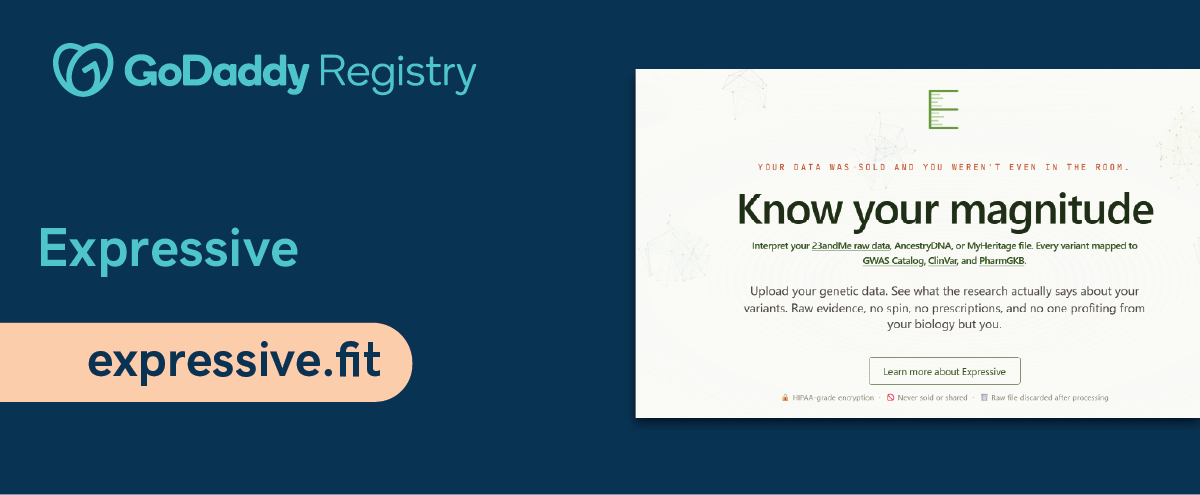
Expressive aims to change this by transforming raw genetic data into an evolving, research-backed resource that helps users better understand how their genes may influence nutrition, exercise, supplements, medications, and overall health.
We sat down with Hunter to learn why he built Expressive, what makes it different from other DNA analysis tools, why downloading your raw DNA file might be one of the smartest things you do this year, and of course, why he built Expressive on a .fit.
From Blockchain to Biology
If you'd asked Ben Hunter five years ago whether building a genetics platform was going to be a passion project of his, the answer would have probably been no.
Before founding Expressive, Hunter built his career in software engineering. Today, he serves as Chief Technology Officer of BTCS, a technology company that develops software for cryptocurrency. Although he also spent time working as a developer in the healthcare industry, genetics was never on his radar.
But solving complex data systems was.
"The common thread is building systems that make complex data actually useful, which is exactly what Expressive is," says Hunter.
Like millions of other people, Hunter had purchased a genetics test years earlier. He looked through the ancestry results, learned a few fun facts, and then ultimately forgot about it. The raw DNA file stayed where it remains for most consumers: sitting on a third-party website, unused. That changed after a conversation with his doctor.
Hunter recalls talking about patients researching medical conditions online before consulting their Primary Care Provider. Rather than dismissing the idea, his doctor surprised him by saying that she actually appreciated it when patients arrived to their appointments informed. Hunter’s doctor further recommended he explore other online tools to learn more from his own data.
Hunter notes that his experience was eye-opening, but ultimately frustrating: the reports were static, often difficult to interpret, and left him with more questions than answers – leaving him to start using AI to navigate the information.
"I realized quickly that AI was making broad assumptions and shouldn't be treated as a source of truth,” comments Hunter, “but it could point me toward real research." So he started reading the studies himself.
This turned into hundreds of hours combing through scientific literature. Along the way, he discovered several risk factors that aligned with his own lifestyle and family history. To see whether the research reflected reality, he ordered bloodwork. The results confirmed what he'd found.
"My liver levels came back elevated. Nothing extreme, but clearly higher than they should be for someone my age."
That was the moment the project became personal, Hunter explains. "Expressive is the service I wish had existed so I didn't have to do all of that manually."
The Info Hidden in Plain Sight
According to Hunter, one of the biggest misconceptions surrounding consumer DNA testing is that the reports stop with ancestry percentages or physical traits. Researchers have spent decades publishing studies that connect specific genetic variants to everything from nutrient metabolism and exercise response to medication effectiveness and disease risk. The problem isn't a lack of science, it's accessibility to the general public.
"There are verified, reproducible studies showing how your body will react to specific supplements or medications. That's genuinely valuable clinical information that's just sitting there, disconnected from the people it's relevant to."
Most consumers never see that research because it's scattered across thousands of academic papers, written for scientists rather than the everyday reader. Hunter believes that's why many people still dismiss consumer DNA tests as novelty products.
"The research connecting specific variants to real health outcomes is much deeper than that."
That realization became the foundation for Expressive. Rather than producing another one-time genetic report, Hunter wanted to build something that evolved alongside scientific discovery.
On Expressive.fit, every uploaded DNA profile is continuously matched against newly published research. If new evidence emerges tomorrow for one of your genetic variants, your profile is updated automatically.
Hunter also made an intentional decision about what wouldn't power the platform. Despite AI playing a role in his own research journey, Expressive doesn't use AI to decide what study is relevant.
"The entire association layer is deterministic,” said Hunter. “No AI, no human judgment deciding what's worth surfacing to you."
Instead, every association is tied directly to published scientific literature, weighted according to the strength of the evidence and the size of the research population. This enables individuals to have access to the same research they could eventually find themselves . . . without spending hundreds of hours searching for it.
Your DNA, Your Data
The uncertainty surrounding 23andMe reinforced another principle Hunter had been thinking about from the beginning: ownership.
When users upload their DNA file to Expressive, the platform extracts the genetic variants it needs and immediately discards the original raw file. The source file isn't retained, and users can delete their information whenever they choose. Similarly, Expressive explicitly promises on their website to never sell or share any of your data to other organizations.
Hunter believes everyone who has taken a consumer DNA test should download and save their raw data. Not because they need to use Expressive specifically, but because it's their personal information.
"Every major provider lets you export it, and it belongs to you."
For Hunter, the raw DNA file wasn’t a souvenir from an ancestry test; it was a lifelong dataset that grew more valuable as science continues to evolve. As the site states, Upload once, query forever. After unlocking its potential himself, he's hoping more people will finally discover what's been hiding in theirs all along.
A Natural .fit
Hunter spent hundreds of hours uncovering meaningful health insights hidden inside his own DNA. When it came time to launch the platform, he wanted every part of the brand to reflect its purpose – including the domain name.
“I was looking for a health-focused domain,” says Hunter, “and felt that combining "Expressive" with the .fit TLD kept things clean while making the platform's intentions clear.”
Expressive.fit is currently in Beta and free to individuals who are interested in exploring their existing DNA data. If you’ve already taken a test through 23andMe or AncestryDNA, you’ve likely already paid for this information – the real question is if you’ve ever put it to use outside of learning your family tree.
If you have your data handy, give it a try. It might be the smartest (and healthiest) thing you do this year.