Key Takeaways:
- Abyss Vanuatu Ocean Institute (AVOI) combines scientific research with traditional kastom knowledge to help Vanuatu prepare for environmental disasters and strengthen climate resilience.
- AVOI’s Vanuatu Ocean Rangers program trains local people to lead environmental monitoring, while its .VU domain reinforces the Institute’s national identity and connection to the communities it serves.
More than 1,000 miles northeast of Australia, scattered across the South Pacific, the islands of Vanuatu are facing a growing environmental crisis. Rising seas, coastal erosion, stronger cyclones, and other pressures are changing the landscapes that communities have depended on for generations. For a nation made up of more than 80 islands, the question is no longer simply what the future will look like, but how prepared Vanuatu will be when it arrives.
Carl and Kevin Fallon want Vanuatu to be better prepared before the next environmental disaster strikes. With more than 25 years of diving experience throughout the Vanuatuan islands and across the Pacific, the two have experienced first-hand the increasing environmental pressures facing Vanuatu – from tropical cyclones and 7.3-magnitude earthquakes, to the broader impacts of climate change and rising sea levels. They also saw a critical gap: without regular baseline data, it can be difficult to establish what has been damaged after an event, understand the full extent of the impact, or determine what recovery should cost.
Their response was to help build the capacity to understand Vanuatu's environment before disaster strikes. That ambition is behind the Abyss Vanuatu Ocean Institute (AVOI), which the Fallons co-founded at Havannah Harbour on Efate as Vanuatu’s first dedicated Ocean Institute. Its work combines scientific research with kastom knowledge (custom knowledge) held by Ni-Vanuatu communities, or the people of Vanuatu. Fallon’s longer-term vision is ensuring that more conservation and climate resilience work can be led by people within the country.
“Preparedness is more cost-effective than retrospective restoration,” Fallon said.
Building the Institute with Vanuatu
Fallon came to AVOI with decades of experience in the marine sector. A scientific diver, he had already worked alongside universities and researchers on marine projects in Australia. That experience gave him a strong technical foundation, but it didn’t tell him what Vanuatu needed.
Fallon spent time with the Vanuatu communities and local leaders, listening to their concerns and allowing their guidance to influence AVOI’s programs. He came to understand that relationships had to develop before decisions could be made.
“Trust cannot be rushed,” he said.
Kastom is central to the way Fallon now thinks about the Institute. The term refers broadly to Vanuatu’s customary practices, traditions, and systems of authority – it encompasses the ways communities understand and relate to land, family, culture, community, and leadership. Communities also hold generations of knowledge about their surrounding environment, from changes in weather patterns to the condition of nearby reefs.
AVOI’s role is to support that understanding with scientific research that can help measure change and create stronger evidence for future decisions.
“I would also tell myself not to feel that I needed to have every answer,” Fallon said. He found that some of the Institute’s strongest ideas emerged when he began asking local leaders and communities what they believed was needed.
“The Institute was never supposed to be something built for Vanuatu and then handed over,” he said. “It needed to be built with Vanuatu from the beginning.”
Training Vanuatu’s Ocean Rangers
One of the clearest signs that Fallon’s vision is taking shape has been AVOI’s Vanuatu Ocean Rangers program. The Ocean Rangers program trains Ni-Vanuatu locals to identify environmental issues and support monitoring by working directly in their own communities. AVOI began with eight founding Rangers, and Fallon hopes the program can eventually extend across the country.
One of Fallon’s proudest moments came when those first Rangers were recognized by Ralph Regenvanu, Vanuatu’s Minister for Climate Change and Environment, and Osbourne Melenamu, representing the ministry.
“You could see their shoulders lift,” Fallon said. “They understood that their work mattered, that their Government saw them.”
The national recognition also demonstrated that AVOI was beginning to move beyond Fallon’s original vision and into something the Rangers themselves could carry forward.
“Abyss Vanuatu Ocean Institute was never meant to be about one founder,” he said. “It was created to build local capability, create opportunities and give Ni-Vanuatu people the training, tools and platform to lead the protection of their own country.”
Why AVOI Chose a .vu Domain
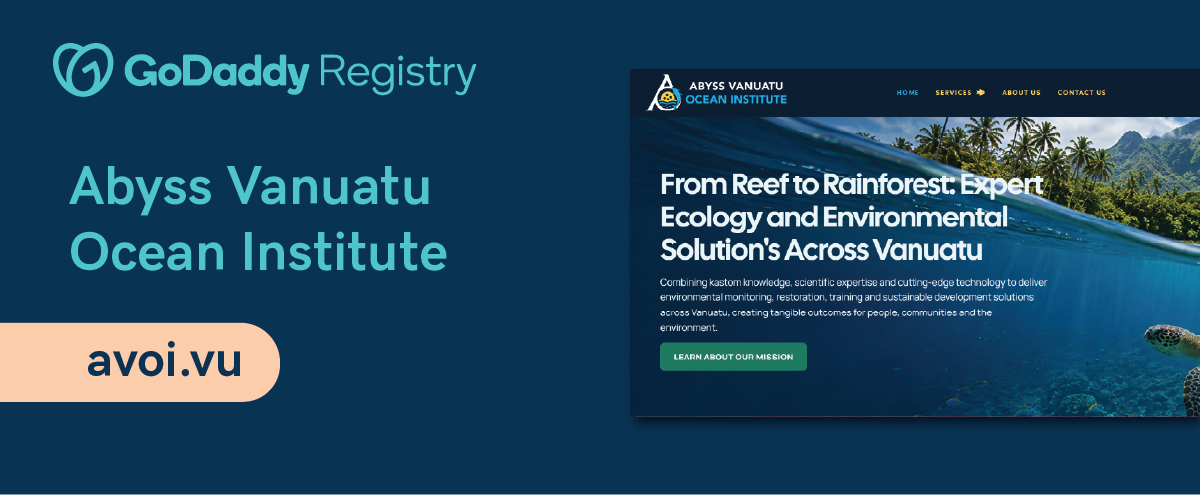
The focus on Vanuatu also influenced Fallon’s choice of AVOI.VU. The .VU extension is Vanuatu’s country-code top-level domain, and he wanted the Institute’s web address to reflect where the work began.
“We chose the .VU domain because Abyss Vanuatu Ocean Institute is distinctly and proudly Vanuatu,” Fallon said. Although its partnerships and ambitions extend across the Pacific and internationally, he sees the Institute itself as belonging to the country where its model is taking shape.
“The .VU domain gives the Institute a clear national identity,” he said. “It reflects where we belong.”
Fallon already has ambitions to take AVOI’s work further. Through the newly formed Pacific Land & Sea Foundation, he hopes the model established in Vanuatu can eventually support other Pacific island countries facing similar climate risks.
If that happens, AVOI’s work could extend far beyond Havannah Harbour, but AVOI.VU will still carry the name of the country where it began.