

Key Takeaways:
- AI search prioritizes broad recommendations over a single best choice. Small businesses can appear alongside major brands, but visibility doesn’t guarantee prominence. Businesses need clear descriptions, strong reviews, and credible online profiles to stand out.
- A strong AI search presence requires more than an optimized website. Maintaining accurate business listings, consistent location information, positive reviews, and helpful, specific content across third-party platforms can improve a business’s chances of appearing in AI-generated answers.
AI-powered search tools like ChatGPT, Google’s Gemini, and Perplexity are rapidly changing how people discover businesses online. Instead of scrolling through pages of Google results, users are now asking conversational questions and getting curated answers instantly.
This shift is completely redefining visibility for small businesses.
This eBook explores how AI search engines currently surface small businesses, using real data collected from our team’s tests to uncover patterns in how businesses are presented, ranked, and recommended. It also breaks down what these patterns mean for your marketing strategy moving forward.
This guide is designed for small business owners, marketers, and agencies who rely on online discovery to drive growth.
If you want your business to be found online, this is no longer optional knowledge.
Key Takeaways
The data reveals a clear pattern: AI search is highly effective at delivering relevant information, but it stops short of making decisions for the user. While the vast majority of responses are aligned with the query, only a small percentage offer a direct recommendation.
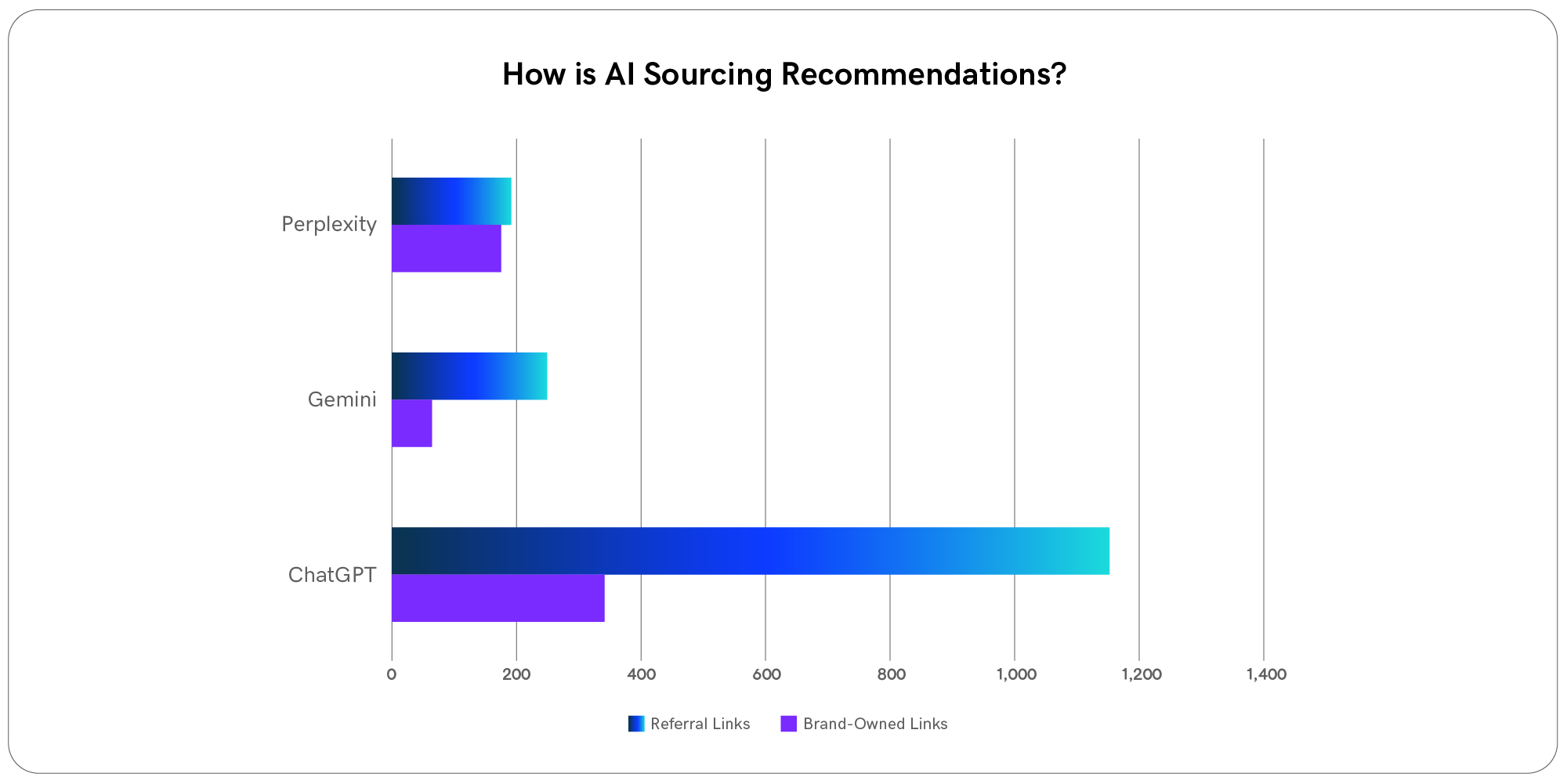
Instead of highlighting a single best option, AI tends to present a broad set of choices. In doing so, it behaves more like a curated directory than a decisive guide. This is reinforced by the overwhelming number of links included in responses, many of which point to aggregator platforms rather than individual business websites.
Notably, AI responses often skew towards small and local businesses, surfacing them alongside or even ahead of the larger, well-known brands. However, visibility doesn’t always translate into prominence, as the small businesses are often buried in longer lists rather than stand-out recommendations.
At the same time, localization is inconsistent, so even queries with clear local intent do not always yield geographically precise answers.
Taken together, these patterns suggest that when it comes to small business recommendations, AI search excels at surfacing options but leaves the burden of decision-making to the user.
Bottom line: AI search is highly effective at surfacing options – especially for small businesses – but is generally less consistent at driving clear, singular decisions.
Methodology & Research Approach
Scope
This research analyzed how AI search tools respond to small business discovery queries across multiple categories, including:
Local services
Restaurants and hospitality
Professional services
General “best of” queries
The goal was to understand how small businesses are represented, ranked, and recommended.
A Note on Data Approach
This study is based on structured, observational testing rather than large-scale quantitative scraping. We conducted controlled, repeatable searches across multiple AI platforms (specifically, ChatGPT, Gemini, and Perplexity) using standardized prompts to identify consistent patterns in how results are generated.
While the dataset is directional rather than exhaustive, the consistency of patterns across platforms and queries provides a strong signal into how AI search systems currently behave.
Query Design
A total of 30 queries were developed to reflect realistic small business discovery behavior. These queries were evenly split to capture two distinct types of user intent:
Transactional queries (50%), where the user is actively seeking a business or service
Informational queries (50%), where the user is gathering guidance before making a decision
This balanced approach allowed for a more comprehensive view of how AI tools respond across the full customer journey: from discovery to decision-making.
We entered the following questions verbatim into each LLM:
Transactional Queries:
Where’s the best pizza place near me that delivers fast?
What’s a good local bakery where I can order a birthday cake?
I need a plumber today—who’s the most reliable in my area?
Where should I go to get my hair colored this weekend?
What are the highest-rated yoga studios near me for beginners?
What’s a good shop to buy a gift for a coworker under $30?
Where can I get my phone screen repaired quickly near me?
What’s a good local boutique for women’s winter coats?
Where’s a great place to buy fresh flowers last-minute?
What’s the best coffee shop near me to work from for a few hours?
Where can I book a massage nearby for this afternoon?
I want to try a new restaurant tonight—what’s trending near me?
Where’s the best place to get custom T-shirts printed locally?
Where can I take my dog for grooming that’s gentle and affordable?
What’s the best local hardware store to buy paint and supplies?
Informational Queries:
What should I buy my grandma for her birthday?
How do I choose a good mechanic without overpaying?
What makes a pizza place truly great—what should I look for?
How do I tell if a bakery uses high-quality ingredients?
What’s the difference between boutique gyms and big-box gyms?
How do I pick a trustworthy local contractor?
What are some unique gift ideas from small businesses?
What makes a coffee shop a good place to work remotely?
How often should I take my dog to the groomer?
What should I look for when choosing a florist for an event?
How do I decide whether to shop at a farmers market or grocery store?
What questions should I ask before booking a massage therapist?
What are the benefits of buying from local boutiques instead of chains?
How do I know if a yoga studio is beginner-friendly?
What should I consider before getting custom merchandise made?
Localization Handling
Queries were intentionally entered without explicitly stating a city (e.g., “I live in Chicago” or “Best pizza in New York City”). Instead, prompts relied on implicit local intent using phrases like “near me” or “in my area.”
This approach was designed to reflect real-world user behavior and allowed us to evaluate how effectively AI systems infer location based on IP data and contextual signals alone.
In this study, “local” refers to queries that imply geographic relevance without explicitly defining it. Because this leaves room for interpretation by the AI system, results may vary depending on how strongly the model weights implicit versus explicit location signals.
Testing Framework
Each query was assessed using a consistent framework that focused on several key dimensions. These included the relevance of the response, the presence and positioning of small businesses, the number and type of links included, and whether the response provided a clear recommendation.
In addition, each response was evaluated for how well it reflected the user’s location, particularly when local intent was implied.
To maintain data integrity, each query was conducted in a fresh incognito browser session. This approach ensured that prior search history, AI interactions, and cached data did not influence the results, allowing us to collect unbiased and consistent findings.
Data Captured
For each response, the following metrics were tracked:
Total number of links provided by the LLM
Number of affiliate vs brand-owned links provided
Number of small businesses included compared to chains or ‘big-box stores’
Positioning of those businesses in the response (top, middle, bottom)
Whether the response was localized
Whether a direct recommendation was provided
Considerations
AI-generated responses are inherently variable and can differ across sessions, platforms, and user contexts. Factors such as prompt phrasing, account history, and model updates can all influence outputs.
Even small changes in wording (e.g., adding a city name or changing intent from “best” to “nearby”) can meaningfully impact results.
For this reason, the findings in this report should be interpreted as directional patterns, not fixed rules. They reflect how AI search behaves today under controlled conditions, not a universal outcome for every user or query.
Findings
1. High Relevance, Low Recommendation
AI consistently delivers relevant answers . . . but avoids strong opinions.
Most responses accurately match the query
Small businesses were more often recommended than larger chains or ‘big-box’ stores
Only a small fraction explicitly says “this is the best option”
Instead, users are presented with multiple acceptable choices. Often times, the AI prompt would ask for more information to personalize the response after the initial list was given, but this was not standardized across all platforms.
Implication:
AI is optimizing for safety and breadth, not decisiveness.
2. Link Volume Is Extremely High
Responses contain a surprisingly large number of links:
~50 links per response on average
~75% of those are affiliate or aggregator-driven
These include:
Yelp
TripAdvisor
Booking platforms
“Top 10” list articles
Implication:
AI heavily relies on existing SEO ecosystems rather than bypassing them.
3. Aggregators Dominate Over Brands
Third-party platforms significantly outnumber direct links to business websites.
This means:
Businesses are often represented through directories
Simply updating your own website is not enough
Implication:
Your presence on third-party platforms matters as much (or more) as your own website.
While small businesses do appear:
They are typically part of long lists
Rarely featured at the top
Rarely singled out as “the best.”
Implication:
Visibility alone is not enough, it’s your positioning within the response matters.
5. Localization Is Inconsistent
The research was conducted using direct, non-VPN internet access in Chicago, IL. Despite local intent in many queries:
Only ~50% of responses were clearly location-specific
Others defaulted to generic or broad suggestions
Implication:
Localization performance is highly dependent on prompt specificity. Queries that include explicit geographic signals (e.g., city names) are more likely to produce accurate local results, while implicit phrasing like “near me” remains inconsistent.
6. Format Favors Exploration Over Decision-Making
Most responses follow a pattern:
Introductory explanation
List of options
Supporting links
This mirrors traditional search results rather than replacing them.
Implication:
Users are still expected to browse and choose, not simply act on one answer.
What This Means for Small Business Owners
A common misconception is that AI search eliminates SEO – but from what we’ve found, that’s not the case. AI reshapes it entirely. Understanding that distinction is the difference between adapting successfully and getting left behind.
The first shift to internalize is that you're no longer just competing for a rank: you're competing for inclusion. Traditional search gave you a ladder to climb, with a coveted "#1 position" at the top. AI search doesn't work that way. It assembles a set of options and presents them as a collective answer. Your goal, then, is no longer to outrank your competitors but to be in the room when the answer gets built. Let’s take a closer look at how you can do that, step-by-step.
A Reality Check
It’s important to be clear: improving visibility in AI search is not a quick fix. Unlike traditional SEO tactics that can produce incremental gains, success here requires consistent effort across multiple surfaces; your website, third-party platforms, reviews, and content.
The businesses that benefit most are not necessarily the largest, but the most consistently credible across the entire digital ecosystem.
Third-Party Websites
Getting into that room depends heavily on where you show up outside your own website. AI systems pull aggressively from aggregators like Yelp, Google Business Profile, TripAdvisor, and industry-specific directories. If your presence on those platforms is thin, outdated, or inconsistent, you're invisible to the very sources that AI consults. Optimizing your website alone is no longer enough - these third-party profiles need the same attention and care.
What AI looks for across all of those sources is brand signals: reviews, consistency of information across platforms, mentions on reputable sites, and clear descriptions of what you actually do. It's less about gaming an algorithm and more about building genuine credibility. The practical implication is that reputation is now a core business asset, not just a nice-to-have.
Content Strategy
Your content strategy needs to shift as well. AI favors writing that is clear, specific, and structured to directly answer real questions people are asking. Phrases like "best plumber in New York for emergency repairs" or "top-rated vegan restaurants in downtown Los Angeles" aren't just good SEO practices, they're the kind of precise, useful language AI systems are built to retrieve and surface. If your content is vague or written to impress rather than inform, it's likely to be passed over.
Closely related is the question of positioning. Because AI typically presents multiple businesses at once, the ones that stand out aren't necessarily the biggest, but are the ones with clearer descriptions, stronger reviews, and a more consistent presence that reads as trustworthy. This means it's worth investing real effort in how your business is described across every platform, not just your own homepage.
Local SEO
Geography still matters, but it requires deliberate reinforcement. AI doesn't always localize results correctly, so you can't assume it will connect you to nearby customers automatically. Consistent NAP information (Name, Address, and Phone) across every listing, combined with geo-specific language woven naturally into your content, gives AI the signals it needs to place you accurately.
Paid vs. Organic Visibility
Finally, it's worth being honest about what's coming. The landscape described here reflects the current moment, but two forces are already reshaping it. First, paid advertising is making its way into AI search. ChatGPT and similar platforms are experimenting with sponsored placements and priority positioning, which could erode organic visibility in the same way it did in traditional search. Second, large corporations are waking up to all of this. As major brands pour resources into AI visibility, smaller businesses risk being crowded out not because they lack quality, but because they lack the infrastructure to compete at scale.
The window to establish a strong AI presence before that consolidation happens is open right now. But it won't stay open indefinitely.
Final Thoughts
The rules of online visibility are being rewritten, and small businesses that recognize this early have a genuine advantage.
AI search isn't a threat to replace SEO, it's much more akin to an evolution of it. The fundamentals that have always mattered, like credibility, consistency, clarity, and a well-managed reputation, will still matter. What's changed is where those signals need to live and how they need to be expressed. A polished website is no longer the whole game. Your presence across directories, review platforms, and aggregators is now just as important as anything on your own domain.
The mindset shift that matters most is moving from chasing rankings to building trust. AI systems aren't trying to identify the most optimized business, they're trying to surface the most credible one. Every review you earn, every profile you keep accurate and complete, every piece of content that answers a real question plainly and specifically; These are the inputs that determine whether your business gets included in the answer or left out of it entirely.
None of this requires a massive budget or a dedicated marketing team. It requires attention, consistency, and an understanding of how the landscape has shifted. The businesses that will struggle are the ones that keep optimizing for a search engine that no longer works the way it used to. The ones that will thrive are the ones willing to meet customers where they actually are: inside the answers, not just below them.
Start with what you can control today: clean up your listings, respond to your reviews, tighten the language on your profiles, and make sure your location signals are consistent everywhere your business appears online. These aren't glamorous tasks, but they are the foundation of AI visibility.
The window is open. The question is whether you'll step through it before the competition does.
Important Note: This data reflects the current state of AI search and should be interpreted as directional insight rather than a fixed benchmark. As platforms evolve, these patterns will continue to shift.